Tuesday, 16 July 2013

Microsoft Asks Attorney General To Release Gag Order On NSA Spying


Microsoft is tired of getting pummeled in the press over reports that it hands over emails and Skype conversations to the National Security Agency. Unfortunately, the federal gag order related to the NSA is so strict that companies can’t even talk about the existence of the program. Today, Microsoft begged issued a strongly worded letter to Attorney General Eric Holder to release the gag order so that that they can dispel rumors.
“I’m writing to ask you to get involved personally in assessing the Constitutional issues raised by Microsoft and other companies that have repeatedly asked to share publicly more complete information about how we handle national security requests for customer information.”
The letter followed a categorical denial that Microsoft provides special access to the NSA. “We do not provide any government with the ability to break the encryption, nor do we provide the government with the encryption keys,” tweeted Microsoft General Counsel, Brad Smith.
Yahoo recently won a court case that will allow it to prove that they fought the NSA, so there’s room for Microsoft to be optimistic.
The full letter has been pasted below:
Dear Attorney General Holder:
I’m writing to ask you to get involved personally in assessing the Constitutional issues raised by Microsoft and other companies that have repeatedly asked to share publicly more complete information about how we handle national security requests for customer information. In my opinion, these issues are languishing amidst discussions among multiple parts of the Government, the Constitution itself is suffering, and it will take the personal involvement of you or the President to set things right.
Since the initial leak of NSA documents, Microsoft has engaged constructively with the Department of Justice,the FBI, and other members of the Intelligence Community on the ground rules governing our ability to addressthese issues and the leaked documents publicly. We have appreciated the good faith in which the Government hasdealt with us during this challenging period. But we’re not making adequate progress. When the Department andFBI denied our requests to share more information, we went to the Foreign Intelligence Surveillance Court (FISC)on June 19 to seek relief. Almost a month later, the Government is still considering its response to our motion.
Last week we requested official permission to publicly explain practices that are the subject of newly-leaked documents that refer to Microsoft and have now been misinterpreted in news stories around the world. Thisrequest was rejected. While we understand that various government agencies are trying to reach a decision onthese issues, this has been the response for weeks. In the meantime, the practical result of this indecision iscontinued refusals to allow us to share more information with the public.
This opposition and these delays are serving poorly the public, the Government itself, and most importantly, the Constitutional principles that we all put first and foremost.
As I know you appreciate, the Constitution guarantees the fundamental freedom to engage in free expressionunless silence is required by a narrowly tailored, compelling Government interest. It’s time to face some obvious facts. Numerous documents are now in the public domain. As a result, there is no longer a compelling Government interest in stopping those of us with knowledge from sharing more information, especially when this information is likely to help allay public concerns.
I feel very fortunate that we have both an Attorney General and a President with such long standing knowledge of and appreciation for our Constitution. Put simply, we need you to step in to ensure that common sense and our Constitutional safeguards prevail.Thank you for your consideration.
Sincerely,
Bradford L. Smith

Bitcoin Transactions Rise As Economic Unrest Hits Argentina


top-50-download-change
Bitcoin has created an interesting solution for problematic economies. Because it allows seamless extraction of wealth out of a bank account and into the cloud, Argentinians have been ramping up usage of the cryptocurrency in an effort to stem the effects of their worsening economy and their choice to go BTC is actually moving the market slightly.
Even as BTC penetration in other countries remains flat or down, Argentina’s portion of Bitcoin downloads has risen from 1% of the whole to 3% and interest in the currency is at an all time high. According to The Genesis Block, the country’s first Bitcoin meetup group started in 2008 with eight members and is now up in the 400 member range.
The post goes into the economic details of the move towards Bitcoin but in short, the Argentinian government fined a group of economists for recalculating inflation to much higher levels than the official party line. In addition, dollars are being used as an alternative currency thanks to a weak peso and the potential for capital controls like those happening in Cyprus. Argentinians just want to get their money out of banks and, to that end, they’re trusting variable BTCs over their own currency.
In all financial reporting there is always a bit of if-then conjecture. However, the rise in interest in Bitcoin in this part of the world connects to some real world political choices. It’s a fascinating example of how the currency is taking on a life of its own and, more importantly, becoming a viable investment alternative.

With Its $5 Billion Share Buyback Program, Yahoo Still Has A Big Pile Of Cash For Acquisitions


marissa Mayer I Must Have It
Yahoo just released its mixed Q2 earnings, and a few sentences may have given the answer everyone was waiting for — yes, Yahoo still has plenty of cash to pursue more acquisitions. Evidence of this lies in the company’s share buyback program. “During the second quarter of 2013 Yahoo repurchased 25 million shares for $653 million,” one can read in the release. Those are part of a bigger $5 billion program. These shares can be reissued and sold for cold cash any day.
Back in September 2012, Marissa Mayer decided to sell 40 percent of Yahoo’s stake in Alibaba for $7.6 billion. $3.65 billion was set aside to reinvest in Yahoo shares, proving that the company is confident in its own future.
“We are happy to announce that as of today we have essentially completed our commitment to return $3.65 billion from our Alibaba Group proceeds to shareholders, repurchasing a total of 190 million shares,” wrote CFO Ken Goldman in today’s earnings release.
But the company will now go even further. It has a $5 billion share buyback authorization with the SEC and it plans to use this authorization in full. In other words, reports of the disappearance of Yahoo’s cash after the $1.1 billion Tumblr acquisition have been greatly exagerated.
For those who are not familiar with a stock buyback program, the stock can either be canceled or reissued at a later date. In case it is reissued it is a big win for the company because existing shares are not diluted and the new shares just keep the same stock number, just like nothing happened.
They are other advantages as well. For example, it shows that Yahoo if very confident, saying more or less that there is no better investment than its own stock. It slightly raises the price of existing shares as there are less outstanding shares.
Screen Shot 2013-07-16 at 11.17.03 PM
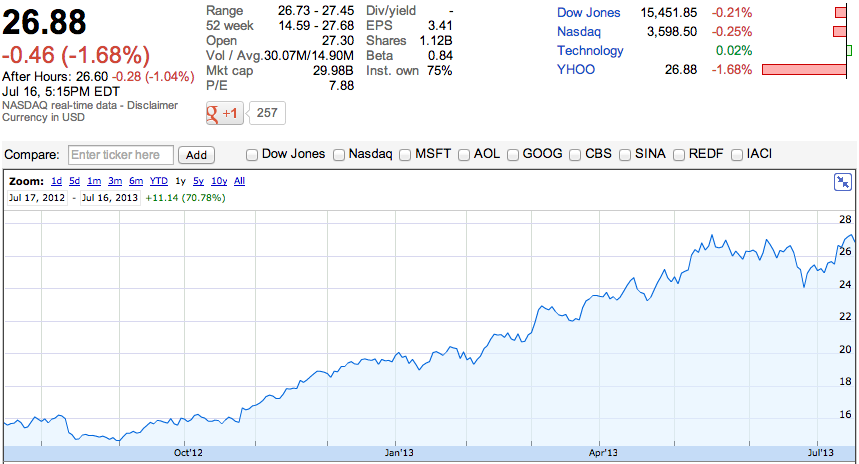
For the past twelve months, Yahoo shares have been doing very well. With a share price of 15.65 on July 16, 2012, today’s price of 26.88 represents an incredible 71.8 percent increase in just a year. That’s better than Google, Apple or eBay.
Yahoo’s share buyback program has paid off so far and the company could spend more than $3.65 billion in acquisitions, because the value of its portfolio is worth more today. As long as the stock goes up, it’s a good strategy.
So today’s earnings taught entrepreneurs and VCs one thing: the acquisition spree can continue.

Google Opens The New Google Maps For Web To Everyone


Screen Shot 2013-07-16 at 2.43.51 PM
Remember that shiny new Maps web interface that Google started showing off at I/O back in May? It’s here!
Technically, the new Maps interface has actually been here for a while… assuming you signed up for an invite shortly after it was announced and were able to make it through Google’s invite queue before they opened the floodgates today. (I signed up a few hours after the announcement and just got my invite a week or two ago.)
Need a refresher on what’s new? Here’s the bulk of it:
  • A new, fullscreen interface
  • Maps now uses vector data rather than graphical tiles for faster loading and handling
  • You can now zoom way, way out. As in, out into space. They’ve built in a Google Earth-esque planetary view, assuming you’re on a beefy enough computer running a compatible browser (Chrome or Firefox)
  • Photo Tours that let you explore famous locations through a series of stitched-together, user-submitted photos. It’s more trippy than it is useful, but it’s still worth checking out. (To see one, go to a major city [like San Francisco] and click the little expansion arrows in the very bottom right)
  • Most routes will automatically show public transport alternatives alongside your driving options
  • Quick comparison charts for public-transport options, graphing the difference in stops/overall time
But wait! Don’t head straight over to maps.google.come and expect the new look just yet. While they’ve ditched the invite queue and the whole having-to-wait bit, you’ll still need to opt in. To do so, just go to this page, scroll down to the bottom, and hit the “Try Now” button. It should let you in immediately.

Marissa Mayer Says Yahoo Has 340M Monthly Users On Mobile, Promises To Improve Display Ads, Video

 s
marissa mayer
One of the big themes that CEO Marissa Mayer kept returning to during the webcast discussingYahoo’s second-quarter earnings was mobile.
“Yahoo’s future is mobile,” she said, noting that the company now sees 340 million monthly mobile users. She didn’t offer any earlier mobile traffic numbers to illustrate growth, but to show the company’s commitment in this area, she said that the mobile team has grown by 6x. Many of those new team members have joined Yahoo through what Mayer called “tuck-in or talent acquisitions,” and she said we can expect those deals to continue at a similar pace.
The webcast actually kicked off with a discussion of the growth that Yahoo has seen with a number of new products, many of them mobile. For example, the number of daily active users to Yahoo Mail on mobile has increased 120 percent since the launch of the tablet app. And since launching the new Yahoo app enhanced by Summly, daily users have increased 55 percent and time spent has increased 60 percent. (One reason to highlight traffic growth: Offsetting the disappointment in the quarter’s flat revenue.)
Overall, Mayer said Yahoo’s traffic (as measured in pageviews) actually grew year-over-year — that might not sound particularly impressive, except that it reflects recent growth offsetting earlier losses. Mobile, she said, is “still early” but also “growing quickly.”
Mayer pointed to mobile as one of four key areas for Yahoo’s future growth. The others are search, display advertising and video, and the last two areas are ones that the company “will begin to clearly address” in the second half of the year, she said.
On display, Mayer acknowledged that Yahoo has “felt some negative impact,” particularly from the growth of programmatic ad buying. She said the company has been making progress with “early efforts” in areas like new ad formats, but later, one of the analysts asked whether the programmatic trend is going to continue driving ad rates down. Mayer argued that these technologies provide “an opportunity to do a much better job to match the right users to the right advertisements,” which could result in ads sold at premium rates.
Mayer also mentioned Yahoo’s Tumblr acquisition, which she said presents opportunities across all four areas. For one thing, she said, she’s working with Tumblr’s David Karp to develop native ads, which she said “can be every bit as good as the content itself.”

Path Is Raising $50M At A $500M Valuation, Still Looking For A Lead Investor


path-500m
Path is raising a $50 million Series C round at a $500 million post-money valuation. Sources tell us the company is still seeking a lead investor, the round is currently oversubscribed, and one of the investors in the round is “a strategic private investment group in Asia.”
Last April, the social network founded by ex-Facebooker Dave Morin raised $30 million at a $250 million valuation.
We’ve also heard rumors that Path has been in acquisition talks with several industry giants. Google, which offered over $100 million to acquire Path in 2011, was the name that came up the most, but sources have said those rumors are false.
This contradicts an earlier report from us that said the company was raising at a valuation as high as $1 billion. Sources say that Path was never raising at a valuation as high as $1 billion, but is still having some difficulty with this Series C.
On the one hand, it’s hard to read too much into investors passing on Path, as that is commonplace in funding rounds. And yet, the timing of the round can’t be great for Path, as it comes at a difficult time in general to be raising, and right on the heels of controversy over the company’s methods for acquiring users, and amid speculation about the company’s userbase.
Onavo Insights tells us that while millions have downloaded the app, active users are declining, at least in the U.S. In June, 1.9 percent of U.S. iPhone users actively used the app, which is down 24 percent from 2.5 percent of users in May.
Additional reporting by Alexia Tsotsis and Kim-Mai Cutler.

TC Cribs: A Trip To Houzz, The Startup HQ That Feels Like Home


Welcome back for a brand spankin’ new episode of Cribs, the TechCrunch TV show that knocks on the front doors of some of the tech industry’s hottest companies to take a look inside their offices.
This time, we headed about 30 miles south of San Francisco to the leafy, sunny, startup-happy paradise that is Palo Alto, California. There we visited Houzz, the startup that brings inspirational home design ideas to the web. Given Houzz’s focus, we expected to find a nice-looking office — and we certainly weren’t disappointed.
Check out the video embedded above to see Houzz’s homey family photos, bustling working area, and the cocoon you can go to if you want to escape it all (with beautiful classical piano music included.)